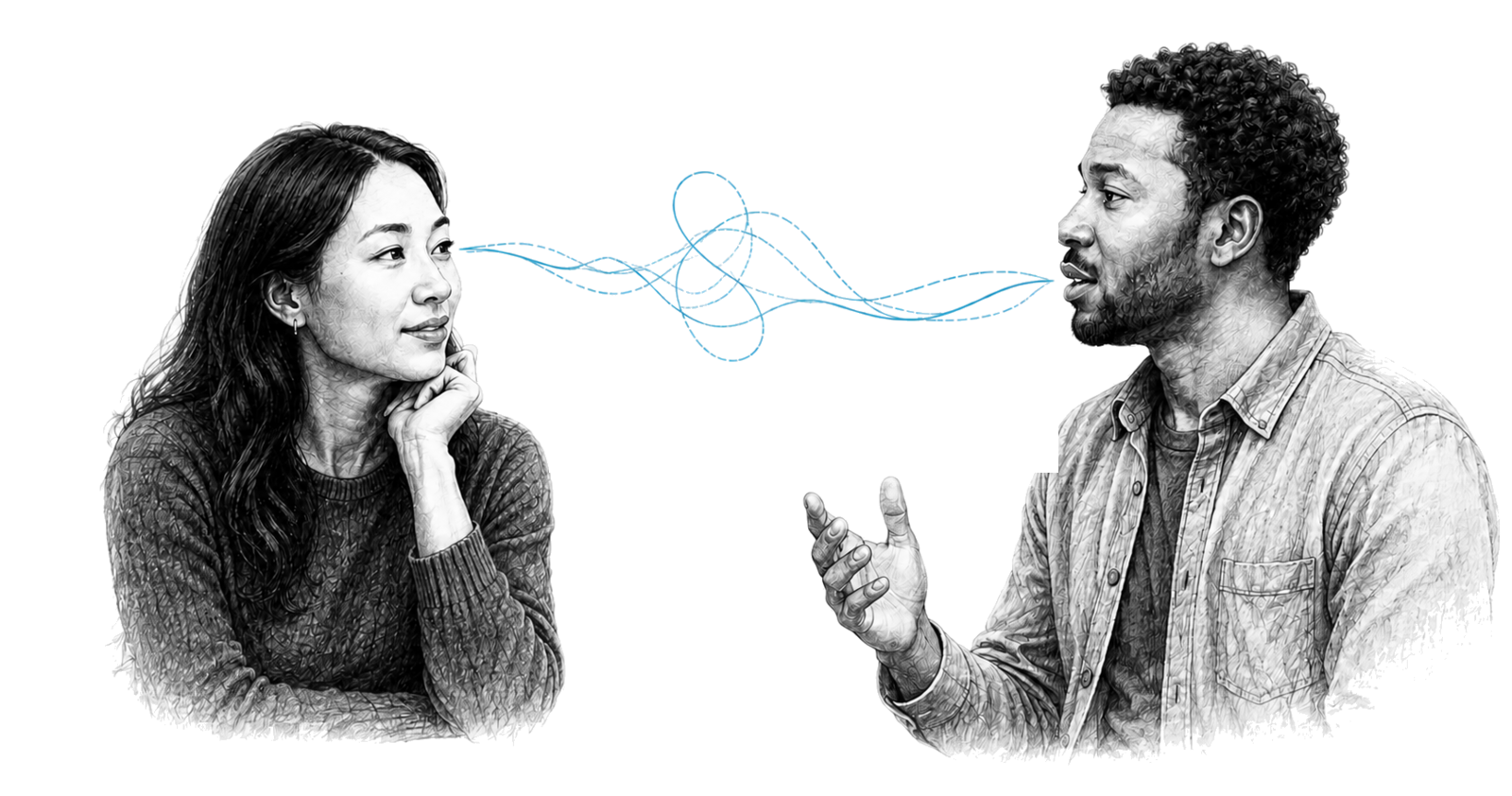
The paradox every language teacher recognises
A learner can complete grammar exercises, understand complex texts and speak accurately when called upon, yet avoid an unscripted conversation outside the classroom. Another learner, with a much smaller vocabulary and visibly imperfect grammar, may initiate conversations whenever an opportunity appears. If language knowledge were converted into communication automatically, this contrast would be difficult to explain.
Peter MacIntyre, Richard Clément, Zoltán Dörnyei and Kimberly Noels began their 1998 article with precisely this problem. Excellent communicative competence, they argued, does not guarantee spontaneous and sustained use of a second language. A person’s willingness to speak can also vary markedly from one situation to another and from one moment to the next. The paper therefore asks a deceptively simple question: what has to happen between being capable of communication and actually entering it?
Is it normal to understand a language but not speak it?
Yes—in the limited sense that comprehension and spontaneous speaking place different demands on a person, and an uneven profile is widely recognisable. While listening, the learner receives words, context and another person’s timing. They can identify enough of the message without having to design the next turn. Speaking requires an intention to be selected, language to be retrieved and organised, pronunciation to be produced and the result to be exposed to an immediate social response. These demands occur under time pressure and cannot be inferred from comprehension alone.
This observation should not be turned into a diagnosis. “Passive language”, “receptive bilingualism”, “speaking block” and “language barrier” are used in different contexts and do not name one single mechanism. A heritage-language speaker who understands family conversation, an adult learner who reads professionally but rarely speaks, and a person who becomes silent only in official encounters may look similar from the outside while having different histories and needs.
The useful first move is therefore descriptive: identify where speech becomes difficult, with whom, for what purpose and with what kind of preparation. The answer may reveal a gap in productive practice, a retrieval problem under time pressure, fear of negative evaluation, an unfamiliar interactional routine—or several of these at once. The MacIntyre model is especially valuable for the situational part of that account.
What the authors were trying to build
The article is not an experiment in which one teaching method is compared with another. It is a conceptual paper. Its authors bring together findings and constructs that had often been studied separately: linguistic competence, confidence, anxiety, motivation, relations between language groups, personality, the immediate interlocutor and the purpose of a conversation. Their goal is to show how these influences might be organised around a single outcome—using the second language voluntarily.
They call that outcome willingness to communicate, or WTC. In the second-language context, WTC is not simply a talkative personality. Someone may be sociable in a first language and reserved in a second; the same person may readily speak with a friend but avoid addressing an unfamiliar group. The relevant state is readiness to enter discourse at a particular time with particular people using the second language. The words “particular time” and “particular people” make the concept situational rather than merely personal.
The pyramid: from slow influences to the next utterance
The best-known part of the article is a six-layer pyramid. Its shape expresses distance from actual communication. At the broad base are influences that usually change slowly: the social climate between groups and relatively stable aspects of personality. Above them sit the affective and cognitive context—attitudes towards language groups, features of the social situation and communicative competence. These conditions matter, but they do not determine every individual decision to speak.
The middle layer contains motivational propensities: motives connected with particular people or groups and a more general sense of confidence in the second language. Closer to action are situated antecedents: the desire to communicate with this person now and the state confidence felt in this particular encounter. These feed into willingness to communicate, understood as a behavioural intention. At the narrow top is communication behaviour itself: speaking in class, joining a conversation, reading a message aloud or using the language in another observable way.
“Knowledge is one part of the pyramid. The decision to communicate is produced by the relationship between knowledge, confidence, motivation, people and the immediate situation.”
Why the model is more useful than “confident” or “shy”
The pyramid resists a common shortcut: explaining silence as a fixed property of the learner. A person can be generally motivated and still decide not to speak because the topic is sensitive, the interlocutor feels threatening or the risk of misunderstanding is unusually high. Conversely, a learner with modest general confidence may speak because the purpose matters, the interlocutor is supportive or the situation makes silence impractical.
This distinction also explains why classroom performance can be misleading. A familiar teacher, predictable turn-taking and preparation time may create strong state confidence. The same linguistic resources can feel unavailable at a service counter where the other person speaks quickly and the queue is growing. The difference does not prove that the learner “knows” the language in one place and has forgotten it in another. It shows that communication emerges from a configuration of resources and conditions.
A different educational goal
MacIntyre and colleagues make a consequential proposal: language education should not stop at producing competence. It should also cultivate willingness to communicate. This does not mean rewarding constant talk or treating silence as a defect. It means creating the conditions in which learners can choose to use the language and gradually encounter a wider range of people, purposes and levels of uncertainty.
For teaching, this suggests that successful practice cannot be defined only by the correctness of a rehearsed answer. It is also worth observing whether the learner initiates, continues after hesitation, asks for clarification and returns to communication after a failed attempt. Support may initially come from preparation, visual cues or a familiar partner. The educational question is whether this support can be varied and reduced without making participation collapse.
What can change without waiting for perfect fluency
If the problem is described only as insufficient knowledge, the apparent solution is always “learn more first”. More vocabulary and grammar may certainly help, but the WTC model suggests additional levers. A task can be made more meaningful, the first interlocutor more predictable, preparation more concrete and the cost of repair lower. The learner can rehearse how to ask for repetition or gain time, not only the ideal sentence they hope to deliver.
Imagine a phone call, a conversation with a child’s teacher and a question at a service counter. All three may require similar grammar, but they differ in visibility, time pressure, familiarity and the consequences of misunderstanding. Practising one generic dialogue does not make the situations equivalent. A functional sequence preserves the purpose of each encounter while varying support: first with a clear scenario and available prompts, later with a changed response, missing information or a less familiar partner.
The aim is not to eliminate every hesitation before real communication. Nor is it to force speech regardless of the learner’s state. It is to make participation possible often enough for strategies and situational confidence to become observable. Progress can then be described more precisely: the person starts sooner, keeps the original purpose in view, asks for help more specifically or remains in the exchange after an unexpected reply.
What the paper does not establish
The pyramid is a heuristic model—a disciplined way of organising possible influences—not a mechanical formula that calculates whether someone will speak. The 1998 article does not demonstrate that every arrow in the model is causal, nor that all factors have equal importance across cultures, ages and contexts. Later studies have tested and revised parts of the WTC tradition, but the original paper itself should be read as a theoretical integration.
WTC also describes readiness to enter communication, not the quality or eventual success of that communication. A willing speaker may still fail to make an intention clear; a reluctant speaker may communicate effectively once interaction begins. The model therefore illuminates the threshold of participation but does not by itself describe every adjustment that follows.
Short answers to the main questions
There is no single clinical or linguistic label that explains every case of understanding without speaking. Receptive bilingualism can describe some family and heritage-language patterns; foreign-language anxiety may help explain some situations; limited productive practice may explain others. A responsible account begins with the pattern and context rather than assigning a universal cause.
It is also not evidence of low intelligence or proof that previous learning was useless. Comprehension is an actual language resource. The practical issue is that the resource has not yet become reliably available for self-initiated action under the conditions that matter to the learner. Speaking practice can help, but its design matters: repetition of fully scripted answers tests something different from entering, maintaining and repairing a changing interaction.
- Can understanding exist without fluent speech? Yes; receptive and productive performance can develop unevenly.
- Will speaking appear automatically after enough listening? It may improve, but the 1998 model gives no basis for assuming automatic transfer in every person or situation.
- Should a learner be forced to speak immediately? The paper does not support a universal rule; participation depends on the person, purpose and situation.
- What should be observed first? The situations in which communication begins, stops, survives a difficulty or is avoided altogether.
The connection to Functional Speech Adaptation
Functional Speech Adaptation begins just before and continues beyond that threshold. It shares the premise that language knowledge alone does not explain situated action. Yet its main interest is what happens after a person enters the exchange: how available language, gesture, context and feedback are reorganised when the first formulation is insufficient.
This connection is an interpretation by the FSA project, not a claim made by MacIntyre and colleagues. Their model helps locate the transition from potential to participation. FSA proposes to study the adaptive work through which participation becomes sustainable and increasingly independent. Together, these perspectives suggest a richer question than “Does the learner know enough?”: under what conditions does knowledge become action, and what helps that action continue when communication changes?
Primary source
This is the paper on which the article is based. The link leads to its DOI or scientific publisher.
- MacIntyre, P. D., Clément, R., Dörnyei, Z., & Noels, K. A. (1998). Conceptualizing willingness to communicate in a L2.
Explains why language competence alone does not guarantee that a person will enter and sustain real communication.
The text above is an interpretation by the Functional Speech Adaptation project; the cited authors do not necessarily use this term or framework.